IT´S FREE AND WITHOUT OBLIGATION! You have nothing to lose and everything to gain! There is NEVER any obligation whatsoever and NO CREDIT CARD REQUIRED.
FULL ACCESS TO WOMEN´S PROFILES AND FEATURES! You´ll have full FREE access to all of the women´s profile information including all available photos and other enhanced features to assist you in exploring your opportunities.
START RECEIVING LETTERS FROM WOMEN! Our real, live, local Matchmakers go to work for you immediately – at NO COST - matching your profile to potential women in their city or region! Most men begin receiving letters from qualified women within a day or two – sometimes even just hours.
OPPORTUNITY TO VIEW WOMEN´S VIDEOS! You´ll have the opportunity to view the women´s profile videos (if available) produced by our local staff and found exclusively here!
YOU ARE IN CONTROL! YOU are in control. YOU choose who, how and IF you want to communicate with a woman. NEVER any obligation!
CUSTOMER SERVICE THAT IS UNMATCHED Questions? Concerns? We invite you to call us or otherwise contact us anytime! Our contact information is at the bottom of nearly every page.
Set Up Your Account Here
Is there any REAL reason to wait? It's FREE, instant and without obligation
to register NOW!
It’s the first step in possibly the most rewarding romantic adventure of your lifetime!
Learning about attachment styles can help couples maintain a healthy
relationship.
Are you a possessive lover? Have you ever been accused of being “too
clingy”? Or are you someone with commitment issues? Do you struggle with
being emotionally vulnerable?
The problems you’re experiencing in your relationships may just have
something to do with attachment styles.
How we were brought up often influences how we deal with other people
and forge bonds. Eventually, these govern how we handle interpersonal
dynamics and conflicts, which is why it’s important to understand
ourselves as best we can for us to have good relationships.
One method of doing this is to determine the cause for some of our most
irrational habits and deep-seated internal issues. This, in turn, can
help explain why we are the way we are with our family, our friends,
and, of course, in our relationships.
So if you have the tendency toward being dismissive with your friends,
or if you’re
prone to jealousy, or even if you’re the type to be in emotionally strong partnerships,
the most likely reasons for these positive and negative behaviors can
boil down to our way of building intimate relations — our attachment
styles.
Attachment Theory and Attachment Styles
Pioneered by British psychologist John Bowlby in the ’50s, attachment
theory began as a research on the link between infants and their
mothers. Later on, it evolved into a series of studies about how humans
create emotional bonds between each other.
Bowlby defined attachment as “lasting psychological connections” and
highlighted how vital a child’s bond is to their mother or primary
caregiver in order to have a normal emotional and social development and
build healthy adult relationships later on.
Further research into attachment theory paved the way for an outline of
the different approaches people have in their intimate relationships.
Depending on how they conduct themselves and express their feelings, as
well as how they react to threats against their emotional connections,
people tend to fall into one of these four categories of attachment
styles:
Attachment styles compatibility is something couples must aspire to
achieve.
Secure attachment style
A secure attachment style is exactly that: an ability to forge healthy
connections with others.
People whose emotional needs were provided from infancy tend to exhibit
this type of connection building. They are comfortable expressing their
needs, able to trust and rely on their partners, and have little to no
fear of attachment.
This is the most ideal of the four attachment styles, and is considered
the gold standard for people in relationships.
Ambivalent or Anxious-Preoccupied attachment style
This second attachment style is characterized by people having high
levels of anxiety over their relationships.
The opposite of Avoidant, which is the next type, someone who is often
called “needy” or “clingy” may possess a constant fear of abandonment
that can be caused by neglect issues from childhood.
A person who is ambivalent or anxious can have attachment needs that
also manifest as overcompensating and always going the extra mile to
make sure their partner doesn’t leave them.
Avoidant attachment style
Dismissive behavior in a relationship can come from someone’s avoidant
attachment style.
If you belong in this group, you’ve probably been called a “lone wolf”
more than a few times in your life, and you’ve built a reputation for
being extremely self-sufficient and individualistic. In your
relationships, you also tend not to depend on your partner for much of
anything, especially in terms of emotions.
Someone dating an avoidant can feel as though their partners are always
cold and closed off, which is why an avoidant and anxious relationship
can lead to a lot of conflicts and misunderstandings.
Disorganized attachment style
Out of all the attachment styles, this one can show the most
inconsistent and erratic patterns of behavior.
Usually exhibited by those who grew up in abusive homes, a disorganized
attachment style can come across as intense fear of rejection as well as
an inability to properly regulate emotions.
These people can be very confusing to their partners, and a relationship
with someone who has this attachment style may be rife with severe
insecurities and even aggression.
Attachment Style Compatibility
The impact of attachment styles in relationships of adults is pervasive
and hard to deny, so in order to have a healthy relationship with your
partner, you need to prioritize attachment style compatibility.
Couples don’t necessarily have to possess the same attachment style, but
knowing what each of yours is and how to accommodate both is a good
place to start.
For example, many people wonder exactly how to deal with avoidant
attachment when they’re someone who is anxious-preoccupied in their
relationships.
After all, can anxious and avoidant relationships work when the two only
seem to exacerbate the negative aspects of each other?
Signs of secure attachment can be seen between any couple as long as
they are prepared to accommodate both their needs and shortcomings. The
important thing to have is the desire to identify areas where conflict
can stem and decide together how to go about addressing them.
So no, you don’t need to figure out how to get out of avoidant
attachment right away, or forcibly push back your anxious or
disorganized tendencies. You don’t even need to force yourself to change
attachment styles, but you do have to acknowledge that to build a
healthy relationship, you have to be willing to grow and meet your
partner halfway.
There are stages to the development of a healthy relationship, and
it’s important to take them step by step.
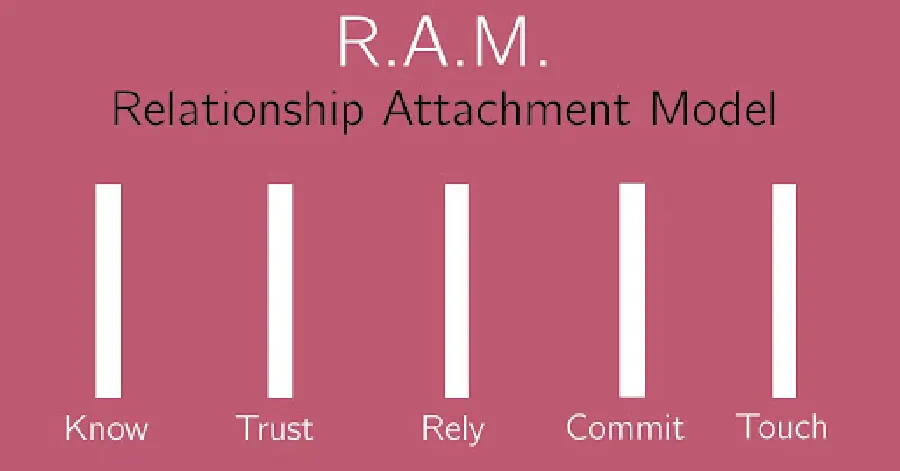
Relationship Attachment Model
Couples don’t need to be experts on the Integrated Attachment Theory or
be certified relationship experts to understand attachment styles and
their impact on
relationship dynamics.
You can start small.
The Relationship Attachment Model, developed by clinical counselor and
dating expert John Van Epp, is a simple resource many people can use in
building healthier emotional connections.
It looks into five aspects that can serve as progressive stages in two
people’s bonding process.
Know
At this stage, you get to learn the most basic things about someone.
Knowledge is the foundation of other deeper levels in a relationship.
The more you get to know someone, the easier it is to forge an emotional
bond with them.
Trust
After knowing essential things about someone — including love languages
and attachment styles — it becomes less difficult to believe in them,
and this is where trust comes in.
The dynamic now shifts into partners being able to have faith in one
another, which is a vital foundation in all healthy relationships. You
need to be able to have confidence in someone despite knowing their
weaknesses and vulnerabilities.
Rely
With knowledge and trust comes reliance: the ability to depend on
someone else without fear or reservation.
Everyone has attachment needs, and people in relationships must be able
to count on their partners to help fulfill them.
Commit
The willingness to commit to someone is the next stage. This is where
you take ownership of the relationship and your responsibilities within
it.
When you dedicate yourself to achieving attachment styles compatibility,
to navigate the nuances of your partner’s lapses and imperfections, you
are one step closer to a relationship that’s worth keeping.
Touch
Physical intimacy becomes easier when couples have met each other’s
emotional needs.
There are plenty of signs of secure attachment, and they don’t often
come in the right order, but the moment touch becomes as fulfilling as
it is primal, you know your bond with your partner is now stronger.
Final Thoughts
The journey to forging strong emotional connections is also a journey in
self-discovery.
Learning about your attachment styles equips you with the knowledge of
how to be a better person as well as a better lover. The first step to
solving a problem, after all, is by acknowledging there is one.
Secure attachments don’t happen overnight, and a healthy relationship
can take a lifetime to build.
If you’re lucky, you may just find someone willing to spend the rest of
theirs working on one with you.